

Instagram Reels for Halifax Businesses: What Actually Reaches Local Customers in 2026

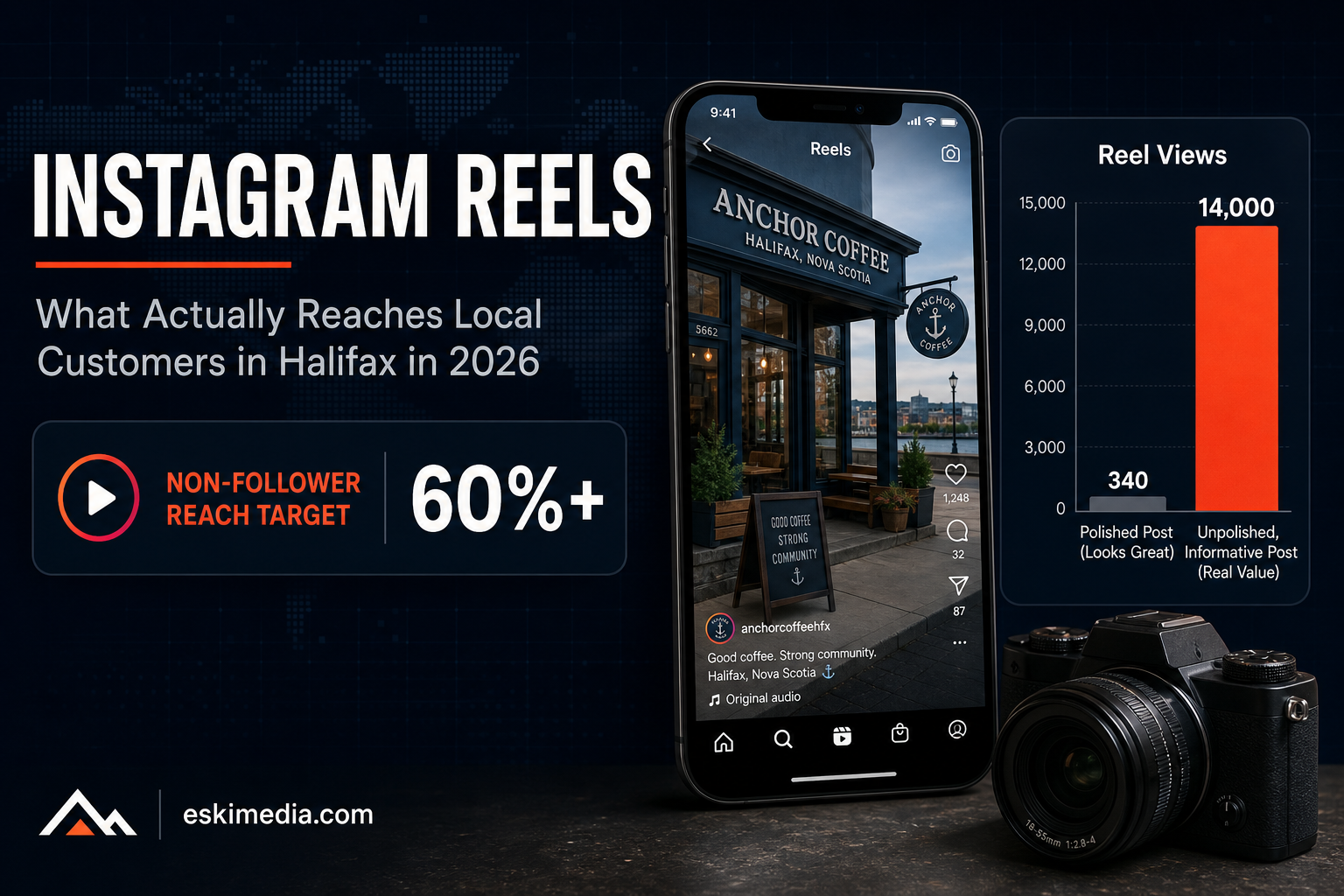
A café in the North End posts a Reel of a barista pouring latte art. It gets 340 views, 12 of them from people who already follow the account, and no new customers. Two weeks later they post a badly-lit 20-second clip of the owner explaining why they moved to a different roaster and what it changed. It does 14,000 views and they run out of beans on Saturday.
Nobody who watches this happen can explain it, so most businesses conclude Instagram is random and stop trying. It isn’t random, but the thing it rewards isn’t what people assume.
Reels Are the Only Discovery Surface Left
Worth being blunt about: in 2026, grid posts reach the people who already follow you. Reels reach people who don’t. If your goal is new customers rather than nurturing existing ones, everything else on Instagram is secondary.
The mechanism behind this is the trial audience. Instagram now shows new Reels to a small test group of non-followers first, and it documents the feature itself. Their behaviour in the first few seconds determines whether it goes wider. Your follower count doesn’t enter into it much, which is why a Halifax business with 400 followers can outreach one with 12,000 — and why the polished content usually loses.
Why the Rough Video Won
Both Instagram and TikTok have signalled that heavily produced content underperforms genuine, unpolished content. For a local business that’s straightforwardly good news: the barrier is no longer a production budget.
But “authentic” gets misread as “low effort,” and that’s not it. The roaster video worked because it had information. It answered a question a customer might actually have, gave a specific reason, and came from someone who obviously knew what they were talking about. The latte art had craft and no content.
A useful test before you post: could someone screenshot this and learn something? If not, it’s a grid post, not a Reel.
What Local Reach Actually Requires
Geotag every single post
Sounds trivially obvious, gets skipped constantly. Tag the specific location, not “Halifax, Nova Scotia” — the actual venue, street or neighbourhood. Location pages get browsed by people looking for things near them, and that’s about as high-intent as Instagram traffic gets.
Go narrow on hashtags, not broad
#halifax has millions of posts and you will never surface in it. #halifaxfood, #dartmouthns, #bedfordnovascotia, #halifaxsmallbusiness, #hrmeats — smaller, but the people in them are nearby and actively browsing. Three to five specific tags outperform thirty generic ones, and thirty generic ones now look like spam.
Mix community identifiers with what you do. A contractor in Sackville is better served by #sackvillens and #novascotiahomes than by #construction.
Say where you are, out loud, in the video
Instagram reads audio. So do the recommendation systems. Saying “we’re on Agricola Street” in the first five seconds does more for local discovery than the same words in the caption, and it tells human viewers something the caption often doesn’t reach them with anyway.
The first two seconds carry the whole thing
No logo animations. No “hey guys.” Start mid-action or mid-sentence. The trial audience decides in that window whether the Reel goes anywhere, and there’s no recovering a slow open with a strong finish.
Content That Reliably Works for Halifax Businesses
Reels for a local business should do one of three jobs: answer a common question, connect to something timely, or show a customer problem being solved. Formats that consistently deliver:
- The question you answer twelve times a week. Pricing, timelines, “do you do X.” You’re tired of the question; your audience has never heard the answer.
- Before and after, with the process compressed. Trades, salons, cleaning, renovations, detailing. Almost unfairly effective.
- The mistake people make. “Three things wrong with this deck that we see every week.” Positions you as the person who knows, without a sales pitch.
- Weather and season, locally. A February storm, the first genuinely warm day, Natal Day weekend, hurricane prep. Timely local content gets shared within Halifax networks in a way evergreen content doesn’t.
- Your actual face, explaining something. Uncomfortable, works better than anything else. For service businesses in a city this size, people hire the person they recognize.
What doesn’t work, consistently: reposted quote graphics, stock footage with text over it, “we’re hiring” as a Reel, and anything that opens with your logo.
A Cadence That Survives Contact With a Real Business
Three Reels a week is the commonly quoted target. Most Halifax owners can’t sustain that alone, and the ones who try burn out around week five and then post nothing for two months — which is worse than a slower steady rhythm.
Two a week, indefinitely, beats five a week for a month. Pick the number you’ll still be doing in March.
The other thing that helps: batch. One two-hour session filming eight to ten clips, then post them out over a month. Shooting one video at a time is where the willpower goes. If filming yourself is the blocker, that’s exactly the kind of thing our social media content service in Halifax handles — we come to you, shoot a month’s worth on site, and hand back edited vertical clips.
Peak posting windows in 2026 land around 7–9am and 11am–1pm in your audience’s time zone, which for a local Halifax business is simply Atlantic time. Don’t over-optimize this; a good Reel posted at 4pm still outperforms a weak one posted at the perfect hour.
Measure Reach, Not Likes
Open your Insights and look at two numbers per Reel: accounts reached and percentage of non-followers. That second number is the one that matters. Above 60% non-followers means the Reel escaped your existing audience and did the job. Below 20% means it played to the people you already had.
Likes tell you your followers approved. Non-follower reach tells you whether you grew. They’re frequently not the same content.
Where Reels Fit With Everything Else
Reels build awareness. They don’t close much on their own. The pattern that works locally is Reels for discovery, profile for credibility, then a link to a website that converts — and if that last part is weak, the whole thing leaks. Plenty of Halifax businesses have a genuinely good Instagram presence pointing at a site that loses people in ten seconds.
If you’d rather not run the camera yourself, or you’re posting consistently and it isn’t turning into enquiries, tell us what you’ve been doing and we’ll take a look at where it’s breaking down.