

Reviews are the cheapest local ranking factor available to a Halifax business, and also the one most owners handle in a way that’s either ineffective or quietly against the rules. Sometimes both.
The rules part matters more in Canada than most guides admit. Google’s own policies are one layer. On top of them sit the Competition Act, CASL and PIPEDA, all of which have things to say about how you solicit and publish customer opinions. Getting this wrong isn’t just a suspended profile. The Competition Bureau treats fake and incentivized reviews as deceptive marketing, and the penalties under the Act are not small.
Why Volume and Recency Beat a Perfect Rating
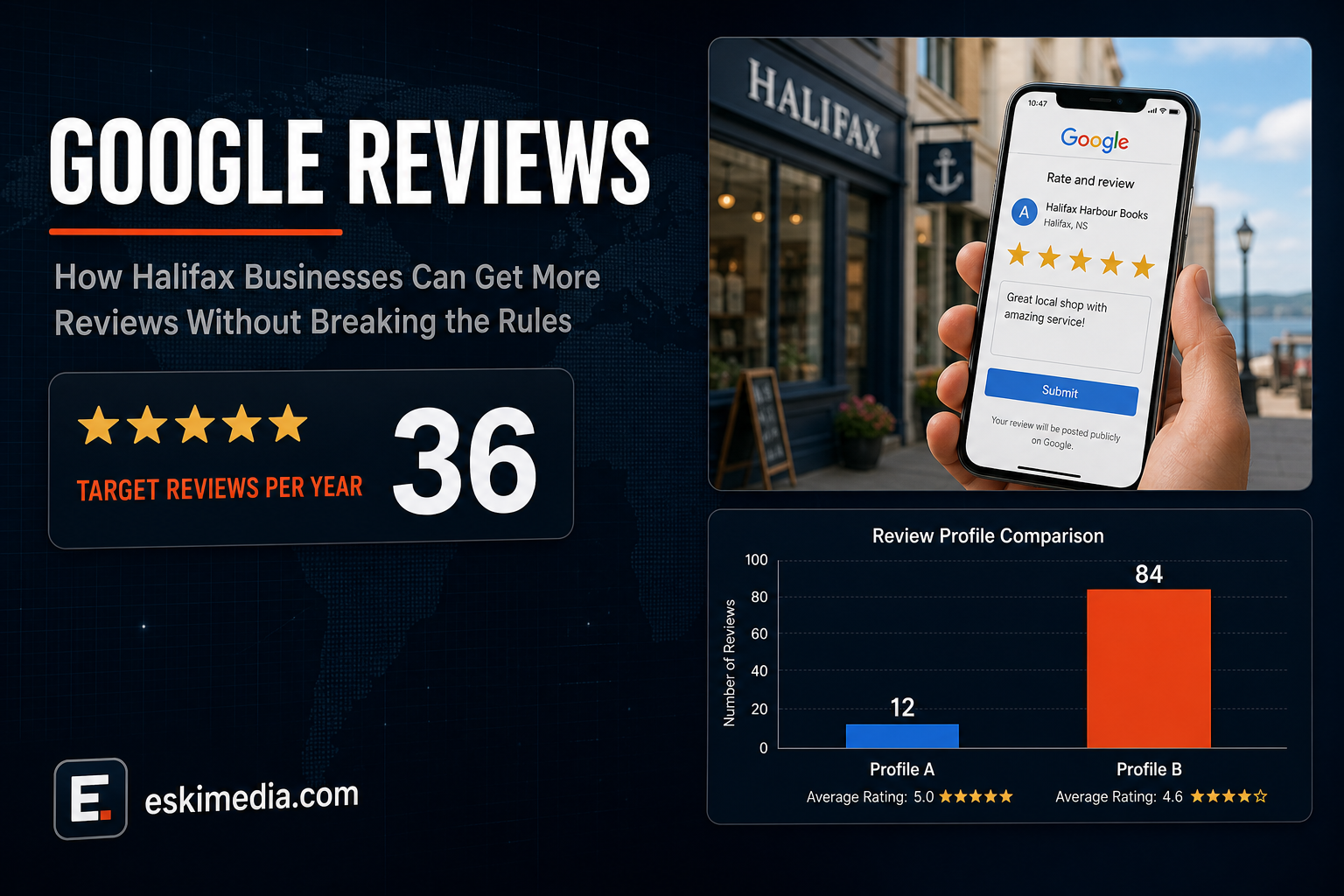
Two Halifax businesses in the same category. One has 12 reviews averaging 5.0. The other has 84 averaging 4.6. The second one almost always outranks the first, and gets more calls.
Three reasons. Volume signals that a real business is serving real customers. Recency signals it’s still operating; a profile whose newest review is from 2024 reads as dormant. And a mix that includes some four-star and the occasional three-star reads as authentic in a way an unbroken wall of five stars does not, to both Google’s spam systems and to actual humans, who have learned to be suspicious of perfection.
AI assistants weigh this the same way when they decide which local business to name. Nothing about a flawless twelve-review profile gives a machine confidence.
The Things You Cannot Do
Short list, but treat it as absolute.
- No incentives. No discount, no draw entry, no free coffee, no “$10 off your next visit for a review.” This violates Google’s prohibited content policy and, because it induces reviews that may not reflect genuine experience, it can put you in Competition Act territory. Even a raffle counts.
- No review gating. Asking customers how their experience was, then only sending the Google link to the happy ones, is explicitly prohibited. It’s also the single most common tactic sold by reputation-management vendors. Don’t buy it.
- No writing your own, and none from staff or family. Google detects clustered IPs and device fingerprints better than people assume, and fake reviews are treated as misleading representations under Canadian competition law.
- No buying reviews. Ever, from anyone, at any price, including services that promise “real accounts, drip-fed.”
- No unsolicited texts. CASL governs commercial electronic messages, and SMS review requests need consent. A customer giving you their number to coordinate an appointment has not consented to marketing messages.
The through-line: you can ask everyone, or you can ask no one. You cannot ask selectively, and you cannot pay.
What Works Instead
Ask at the moment of visible satisfaction
Not at invoice time. Not in a follow-up a week later. The moment the customer says something positive out loud: when the roof looks right, when they see the finished photos, when the problem is fixed and they’re relieved. That’s the window, and it’s short.
For a trades business in HRM, that’s standing in the driveway at handover, not in a follow-up email three days on. Ask verbally, then send the link while you’re still there.
Remove every possible step
Get your direct review link from your Business Profile. Search your business on Google, open the profile, click “Get more reviews,” copy the link. Shorten it. Then put it everywhere friction lives:
- A QR code on the invoice, the counter, the truck, the receipt
- The link in your email signature and in your job-completion email
- A saved text message you can send in two taps from your phone
Every extra tap costs you conversions. “Search for us on Google and leave a review” loses most people at the search step.
Ask specifically, not generally
“Leave us a review” produces “Great service, thanks.” Useful to nobody. “If you have a minute, it really helps us if you mention what we did and roughly where you are” produces “They replaced our roof in Fairview in two days and cleaned up properly” — which contains a service, a neighbourhood and a timeframe, and is worth several times more for local search and for AI citation.
You’re not scripting them. You’re telling them what’s helpful. That’s allowed and it’s the difference between reviews that rank and reviews that just sit there.
Reply to all of them, fast
Response speed became a more visible engagement signal in Google’s 2026 local weighting, and it’s also the cheapest thing on this list. Reply to positives briefly and specifically. Name the job, not “Thanks for the kind words!” pasted forty times.
For negatives: respond within 24 hours, publicly, without arguing. Acknowledge, state what you’re doing, move it offline. Future customers read your response to the one-star far more carefully than they read the five-stars. A calm, specific reply to a bad review has sold more work than most people realize.
A Realistic Target
Aim for two to four new reviews a month, indefinitely. That’s it. Boring and it compounds — 36 reviews a year outpaces almost every competitor who does this in bursts.
What kills it is the campaign mentality: 20 reviews in one week, then silence for nine months. That pattern looks unnatural to Google’s systems and leaves you with a stale profile anyway. Steady beats spiky.
Getting Negative Reviews Removed
Mostly, you can’t, and you shouldn’t spend energy trying. Google removes reviews that violate policy — spam, off-topic content, conflicts of interest, personal attacks, reviews from someone who was never a customer. It does not remove reviews that are simply unfavourable, and flagging them repeatedly achieves nothing.
If a review is genuinely fake or from a competitor, flag it once through the profile, document it, and then bury it with volume. Twenty new legitimate reviews affect your average and your credibility more than one deletion ever would.
Where This Fits
Reviews are one input into local visibility alongside your profile, your website and your citations — powerful, but not a substitute for the rest. We build review generation into our SEO work for Halifax businesses because it’s usually the fastest-moving lever on a new account.
If you want a look at how your review profile compares to the competitors ranking above you, get in touch — it’s a quick check and it’s often more revealing than people expect.