
Google Business Profile Changed in 2026: What Halifax Businesses Should Fix Now

If your Google Business Profile has been sitting untouched since you set it up, it’s probably worth less to you now than it was eighteen months ago. Not because you did anything wrong. Google changed what the profile is for.
The short version: local ranking has moved away from rewarding history and toward rewarding recent activity. Several features you may have been relying on are gone. Here’s what changed and what to do about it, in the order that matters. (If you haven’t claimed a profile at all yet, start with our step-by-step setup guide for Halifax businesses and come back to this after.)
The Big One: Prominence Gave Way to Popularity
Google’s local ranking has long been described as relevance, distance and prominence. Prominence meant accumulated signals: how long you’ve been around, your backlink profile, total review count. Slow to build, but stable once you had it.
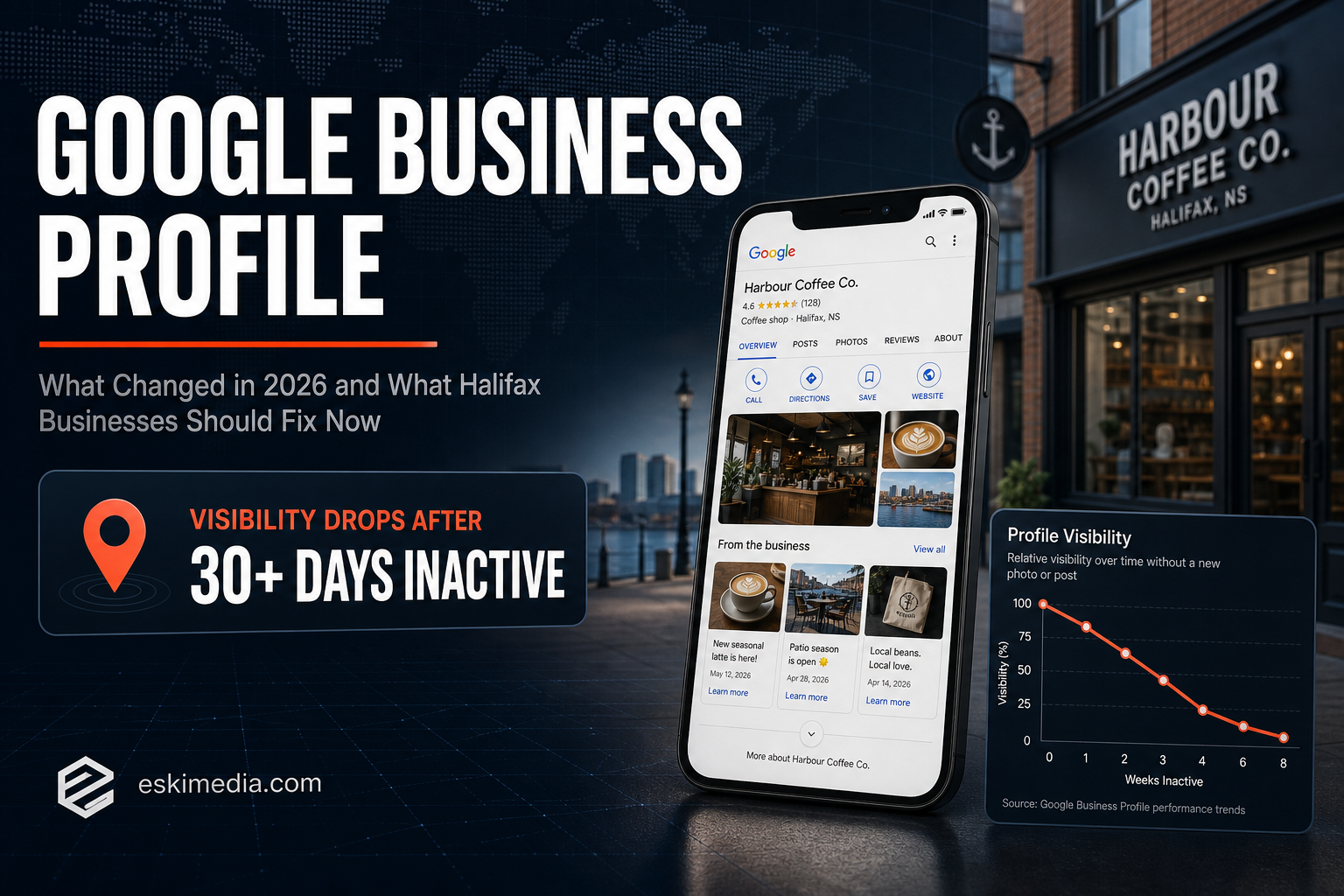
Through 2026 the weighting shifted noticeably toward current engagement: how many people are clicking, calling, requesting directions and interacting with your listing right now. Multiple local SEO practitioners have documented visibility drops on profiles that go 30 or more days without a new photo or post.
The practical consequence is uncomfortable for established businesses. A Halifax company with fifteen years of history and 90 reviews can now be outranked by a two-year-old competitor who posts weekly and replies to every review within a day. Longevity used to be a moat. It’s now a tiebreaker.
And if you’re newer, this is the best local SEO news you’ll get this year.
Q&A Is Gone. Ask Maps Replaced It.
The old Questions & Answers section — where customers asked things and you or a random stranger answered, has been retired. In its place is an AI feature that generates answers from your profile data, your reviews, and your website.
This matters because you no longer directly control the answer. The AI does, drawing on whatever it can find. As of 2026, AI-drafted responses queue for you to review, edit or reject before publishing, which is the part most business owners don’t know exists. If nobody’s checking that queue, answers are going out about your business that you’ve never read.
Do this: log in, find the queue, and set a reminder to check it weekly. Then make sure your hours, services and attributes are complete (Google’s own representation guidelines set out what’s allowed in each field), because that’s the raw material the AI is working from. Thin profile in, wrong answers out.
Messaging Moved to WhatsApp
Google has been phasing out its own native chat and now lets businesses add WhatsApp as the messaging channel. Whether this is useful depends entirely on your customer base. For parts of Halifax’s newcomer communities, WhatsApp is the default way people communicate, and this is a genuine advantage. For a Dartmouth accounting firm whose clients call or email, it’s noise.
Only turn it on if someone will actually respond. An unanswered message channel is worse than no channel.
Your Primary Category Is Still the Highest-Leverage Field
This hasn’t changed, and it’s still the single edit that moves Maps visibility more than anything else on the profile. Switching from a broad category to the specific one that matches what you actually sell can reshuffle your rankings overnight.
A concrete example: “Marketing Agency” and “Internet Marketing Service” and “Web Designer” pull very different search queries. If most of your revenue comes from websites, being categorized as a general marketing agency means competing against every consultant in HRM for queries that aren’t yours.
Pick the primary category that matches your highest-value service. Add the rest as secondary. Then leave it alone for a couple of months and read the Insights before changing it again, because this is not a field to fiddle with weekly.
Photos Became a Ranking Pillar, Not Decoration
Visual content moved from nice-to-have to something Google visibly favours. Profiles with recent, genuine, geographically consistent photography outperform profiles with a logo and four stock images.
Genuine is doing work in that sentence. Photos with real EXIF data, shot at your actual location, showing your actual team and premises, carry signals that a purchased stock photo of a generic office does not. This is a place where paying for one proper photography session in Halifax pays for itself across your profile, website and social channels at once.
A reasonable cadence: three to five new photos a month. Interior, exterior, team, work-in-progress, finished results. Not all at once; spread them out, because recency is the signal.
Completeness Is Weighted Harder Than It Used to Be
Attributes — wheelchair accessible, free parking, LGBTQ+ friendly, appointment required, languages spoken, women-owned — now carry more weight in relevance calculations than they did a couple of years ago. Every blank field, missing attribute or stale holiday hour is a small trust gap.
Nova Scotia-specific note: get your holiday hours right for Natal Day, Remembrance Day and the December stretch. “Hours may differ” showing on your listing during a long weekend sends people to whoever’s listing says “Open.”
A 30-Day Plan That’s Actually Realistic
Nobody’s going to do all of this. So here’s the order:
- Week 1: Audit the primary category. Fill every attribute. Fix holiday hours through the end of the year.
- Week 2: Find the Ask Maps answer queue and clear it. Reply to every review you haven’t answered, including the old ones.
- Week 3: Upload five real photos. Write one Google Post about something concrete — a job you finished, a service you added, a seasonal offer with a date on it.
- Week 4: Set up the habit. One post a week, two or three photos a month, review replies within 48 hours. Put it in a calendar or it won’t happen.
That fourth week is the whole game now. The 2026 algorithm rewards a maintained profile, and maintenance is a habit problem rather than a knowledge problem.
If You’d Rather Not Manage It
Profile maintenance is genuinely tedious, and it’s the part most businesses abandon in month two. We run it as part of our Halifax SEO service — posts, photos, review responses, category testing, the lot.
If you’d rather just know where you stand first, ask us for a profile audit. We’ll tell you what’s missing and what to fix in what order, and you can take it from there yourself if you like.