
How to Get Your Halifax Business Recommended by ChatGPT and Google’s AI Overviews

Ask ChatGPT for a web designer in Halifax. Then ask it for a plumber in Dartmouth, and a physiotherapist in Bedford. You’ll notice something: it names one to three businesses, confidently, and everyone else might as well not exist. There’s no page two.
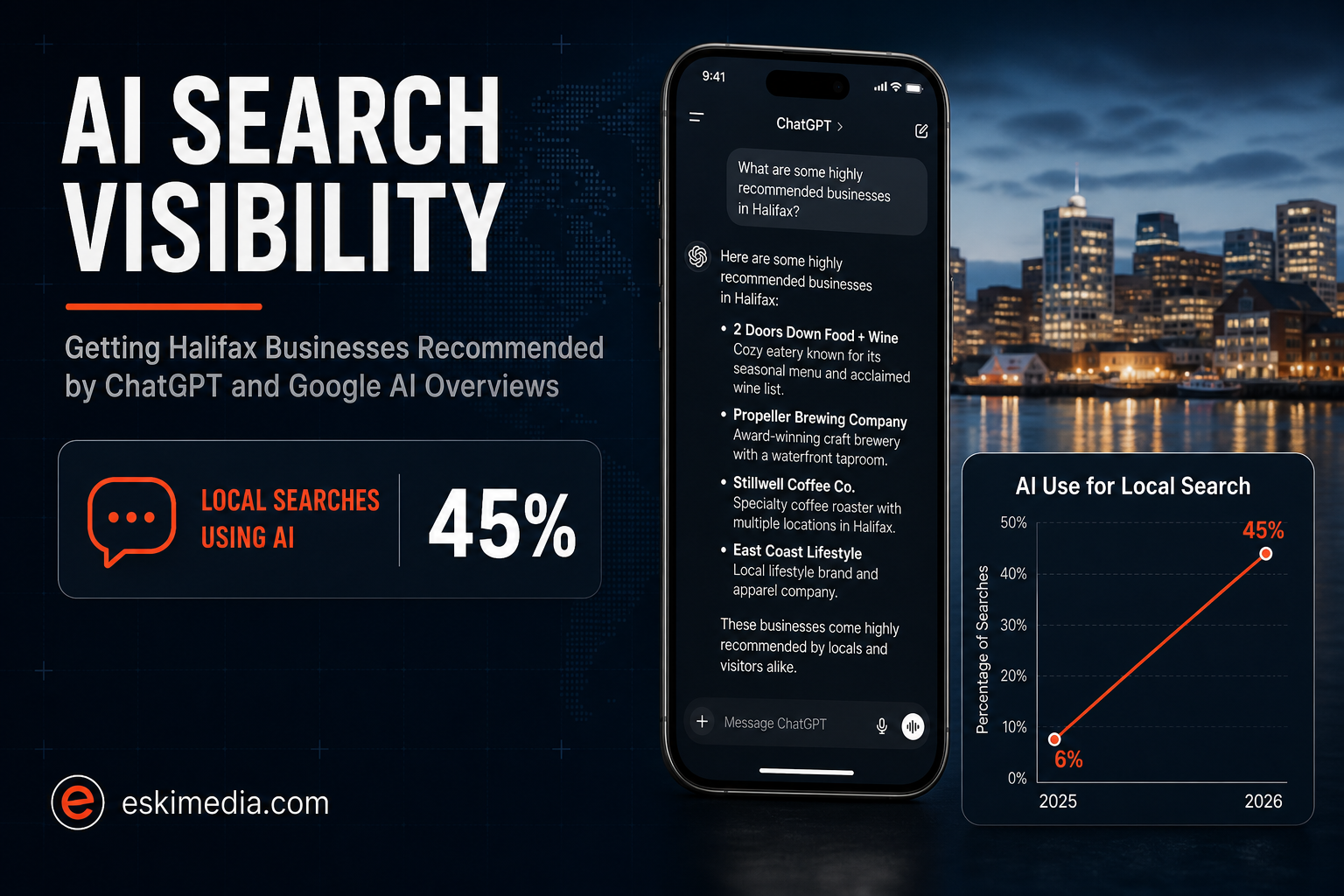
That’s the shift. Google’s local pack shows three businesses but sits above ten organic results and a map you can scroll. An AI answer shows three businesses and stops. And AI use for local searches went from roughly 6% of people in 2025 to about 45% in 2026, a change in behaviour fast enough that most Halifax businesses haven’t noticed it happening to them yet.
Why AI Recommends Some Businesses and Not Others
This is the part worth understanding properly, because it changes what you’d actually do about it.
An AI assistant answering “best videographer in Halifax” isn’t ranking pages the way Google’s algorithm does. It’s searching, reading several sources, and then deciding which businesses it can describe accurately enough to name. Naming a business it might be wrong about is a failure state for these systems. So it defaults to the ones that are easiest to verify.
Which means the winning signal isn’t authority in the traditional SEO sense. It’s consistency and specificity. If your business name, address, phone number, service list and pricing all match across your website, your Google Business Profile, and three directories, the machine can state facts about you without risk. If your website says you serve “Atlantic Canada,” your GBP says Halifax, and an old directory listing has a phone number from two offices ago, every contradiction shaves off confidence, and confidence is what earns the mention.
Currently something like 1.2% of business locations get recommended by ChatGPT for local service queries, against 35.9% appearing in Google’s local three-pack. The bar is low right now. It won’t stay low.
What Actually Moves the Needle
1. Fix your NAP before anything else
Name, address, phone. Identical everywhere, character for character. “Suite 200” versus “Unit 200,” “St.” versus “Street,” a 902 number on your site and a toll-free on your Facebook page — these read as different entities to a machine trying to reconcile sources. It’s tedious, unglamorous work and it’s the highest-leverage hour you’ll spend.
2. Put real numbers on your pages
AI systems cite pages that contain specific, attributable facts. “We offer competitive pricing” is unusable. “Our starter web design package is $149 and includes mobile optimization” can be quoted directly, and when it gets quoted, you get named.
Same logic applies to turnaround times, service areas listed by community rather than region, equipment you actually use, and the year you started. Vagueness is the enemy here in a way it never quite was with classic SEO.
3. Write like a practitioner, not a brochure
First-person accounts of how you do the work outperform generic service copy, because they contain details that only someone doing the job would know. A page explaining why basements in older South End homes are hard to photograph, and what you do about it, is more citable than a page saying “professional photography services in Halifax.” One has information. The other has adjectives.
4. Get reviewed on platforms outside Google
Businesses with profiles on third-party review platforms show up in ChatGPT citations at roughly three times the rate. And volume beats perfection — 200 reviews at 4.8 stars reads as more trustworthy to these systems than 15 reviews at a suspiciously clean 5.0.
5. Show up in local media and community sites
Local news sites, business association directories, chamber pages and community blogs get crawled often and cited heavily for location-based questions. Sponsoring a Sackville minor hockey team and getting listed on the league site is, weirdly, an AI visibility tactic in 2026.
6. Let the crawlers in
Check that your robots.txt isn’t blocking GPTBot, ClaudeBot, PerplexityBot or Google-Extended. (Google publishes its own guidance on AI features in Search, and the short version is that the same crawling and indexing rules apply.) Plenty of sites block them by default through a security plugin and nobody notices. Also make sure your key facts are in the HTML rather than loaded by JavaScript after the fact, because several AI crawlers don’t execute JS, so a beautifully animated services section can be genuinely invisible to them.
What You Can Safely Ignore
A lot of what’s being sold as “AI SEO” is repackaged basics with a markup. Specifically:
- Cramming in question-format headings. Helpful if people ask those questions. Useless as a mechanical tactic.
- “llms.txt” as a silver bullet. Harmless, cheap, currently honoured by almost nothing. Add it, don’t budget for it.
- Anyone promising a fixed position in AI answers. These outputs vary between users and between sessions. There is no rank three.
Does This Replace Regular SEO?
No, and treating it as separate is the most common mistake. AI assistants largely read the same web Google indexes, and their local answers lean heavily on Google Business Profile data, review platforms and well-structured websites. The work overlaps by maybe 80%.
What changed is which 20% matters. Traditional local SEO optimizes to be ranked. AI search optimization means being describable — a clean, consistent, fact-dense entity that a machine can talk about without hedging. If you’ve already done proper local SEO in Halifax, you’re most of the way there and the remaining gap is usually specificity, not effort. If you’re starting from nothing, what local SEO actually involves is the more useful first read.
A Reasonable First Step
Open ChatGPT and ask it what your business does. Then ask it to recommend businesses like yours in Halifax. Whatever it says — including “I don’t have information about that” — is your baseline, and it’s more informative than most audits.
If it gets your services wrong, or doesn’t know you exist, that’s a fixable problem and it usually traces back to inconsistent information rather than anything exotic. Send us what it told you and we’ll tell you where the gap is.