

A Bedford realtor called us last spring, mid-panic. She’d hired someone off a Facebook group to shoot aerials of a waterfront listing for $150. The footage looked fine. Then the brokerage’s compliance officer asked for the pilot’s certificate number and proof of liability coverage, and the whole thing fell apart three days before the listing went live.
This comes up more than you’d think. Drone work in Canada is regulated aviation, not photography with a longer lens, and hiring the wrong person shifts real risk onto you. Here’s what actually applies in Halifax in 2026.
The short answer is yes. If drone footage is being used to market a business or a property, that’s a commercial operation under Canadian Aviation Regulations Part IX: registered drone, certified pilot, and for most locations in HRM an Advanced certificate plus an airspace authorization filed in advance. The rest of this explains what that means when you’re the one hiring.
Any Commercial Drone Flight Is a Regulated Operation
Transport Canada draws the line at purpose, not payment. If the footage is going toward marketing a property, documenting a job site, or promoting a business, it’s not recreational, even if the pilot flew it for free as a favour. Recreational exemptions don’t apply, full stop.
For drones between 250 grams and 25 kilograms (which covers essentially every commercial camera drone — a DJI Mavic sits around 900g), three things are non-negotiable:
- The drone is registered with Transport Canada and the registration number is marked on the airframe
- The pilot holds a valid certificate, Basic or Advanced depending on where and how they’re flying
- The flight is planned for the airspace it’s actually in, which in HRM is the part most people get wrong
Basic vs. Advanced: Why It Matters for Your Shoot
A Basic certificate covers uncontrolled airspace, staying more than 30 metres horizontally from people who aren’t part of the operation, and never flying over them.
An Advanced certificate is required the moment any of that stops being true — controlled airspace, closer than 30 metres to bystanders, or directly overhead. It requires a harder written exam plus an in-person flight review with a Transport Canada flight reviewer, and the drone itself needs a manufacturer’s safety assurance declaration for the operation type.
Here’s the practical part: most commercial work in Halifax needs Advanced. Not because the rules are unusual here, but because of our geography.
Halifax Airspace, Specifically
Halifax Stanfield International sits in Enfield, and its control zone reaches well out over Fall River and parts of Waverley. Twelve Wing Shearwater in Dartmouth is an active military aerodrome — flying near it requires authorization from the Department of National Defence, and that isn’t a same-day request. The Halifax Infirmary and the QEII have helicopter traffic. The harbour has its own considerations.
Practically speaking, a shoot in Burnside, parts of Dartmouth, Fall River, Enfield or Elmsdale is very likely to need an RPAS Flight Authorization through NAV CANADA’s NAV Drone system before anyone powers up. A licensed operator files that in advance. Someone flying casually just… doesn’t, and you find out later.
Insurance: Not Legally Required, Almost Always Contractually Required
This trips people up. Transport Canada does not mandate liability insurance for RPAS operations. But your brokerage, your general contractor, or the property owner almost certainly does. A $1 million minimum is the common ask in Nova Scotia, and larger real estate brokerages and commercial GCs frequently want $2 million or more before a drone goes up over their site.
So when you’re comparing quotes, “are you insured?” is a more useful question than “are you licensed?” A licensed pilot without coverage still leaves you exposed if a drone comes down on a client’s car.
What Non-Compliance Actually Costs
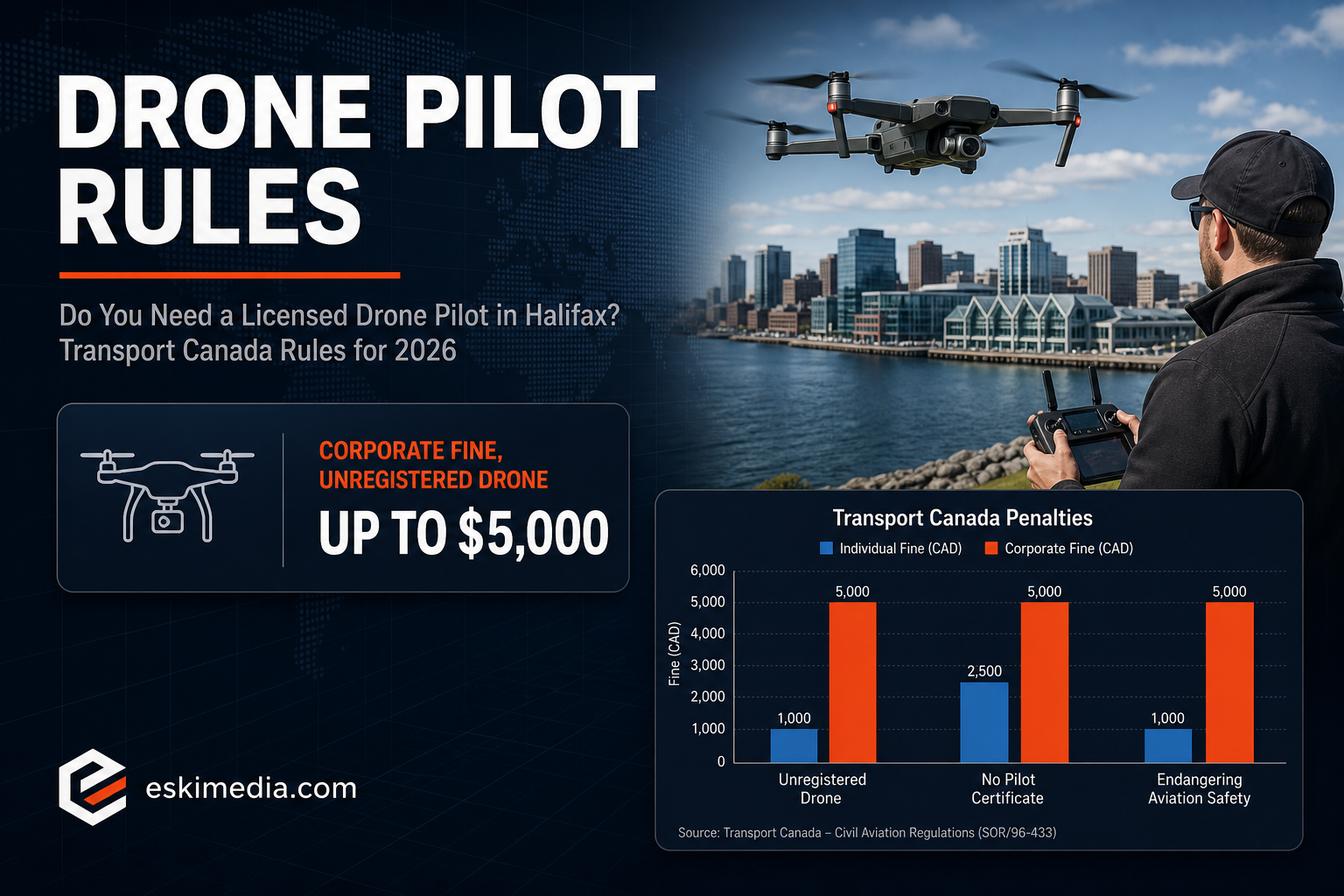
Transport Canada’s penalty schedule is published, and the numbers are specific:
- Flying an unregistered drone: up to $1,000 for an individual, $5,000 for a corporation
- Flying without a valid pilot certificate: up to $1,000 individual, $5,000 corporation
- Operating in a way that endangers aviation safety: up to $3,000 individual, $15,000 corporation
Violations stack. And the exposure isn’t only the pilot’s — if you commissioned a flight and it goes badly, expect to be part of the conversation about who authorized what.
Five Questions to Ask Before You Hire
None of these are unreasonable. A working commercial operator will answer all five in about ninety seconds.
- What certificate do you hold, and can I see the number? Certificates are verifiable through Transport Canada’s Drone Management Portal.
- Is the drone registered, and what’s the registration number?
- What’s your liability coverage, and can you send a certificate of insurance?
- Does this location need a flight authorization, and have you checked? If they don’t know what NAV Drone is, that’s your answer.
- Do you run a site survey? Documented pre-flight assessment is both a safety practice and, if something ever goes wrong, the record that shows the flight was planned rather than improvised.
What You Should Expect to Pay in HRM
Compliance costs money, and the pricing reflects it. Around Halifax, aerial stills and short video for a residential listing generally land in the $250–$500 range. Construction progress documentation on a recurring monthly schedule runs higher, and commercial or cinematic work with a full edit goes up from there. Anything advertised at $100 flat is almost certainly someone flying without the certificate, the registration, the authorization, or the insurance — sometimes all four.
That’s not a pitch for expensive drone work. It’s just where the floor is once you account for what’s legally required to be in place.
Where We Sit
Fair to hold us to the same list. Eski Media flies on an Advanced RPAS certificate, the one that covers controlled airspace and operations near people, and we file the airspace authorizations ourselves rather than handing that back to the client as their problem. Ask us for the certificate number exactly the way you’d ask anyone else.
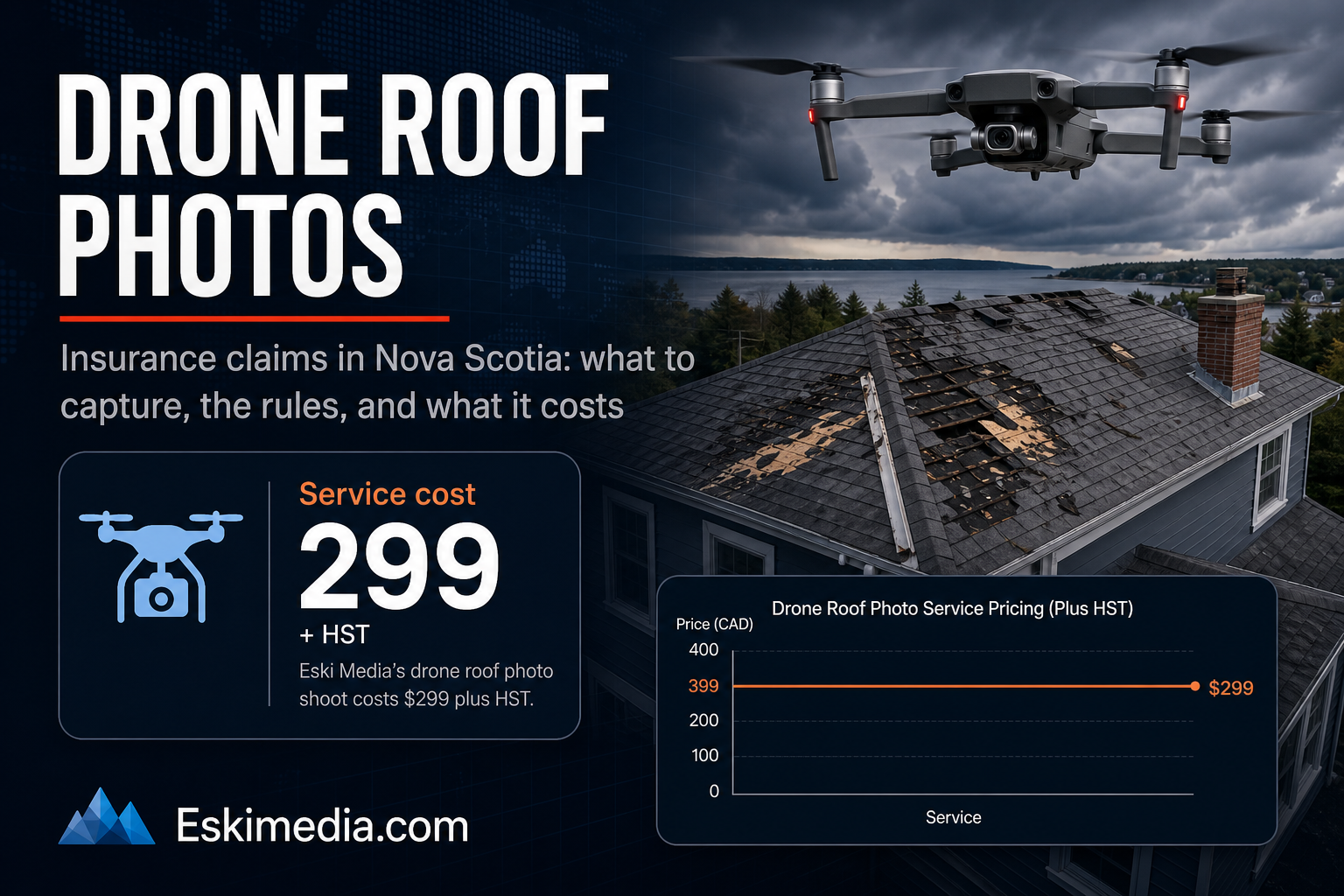
We handle aerial work as part of our drone videography service in Halifax, usually paired with ground-level footage on the same visit: one crew, one schedule, one invoice. A drone shoot on its own is $299 plus HST and comes back as raw footage; the full package, shot and edited with ground coverage included, is $349. For real estate specifically, aerials tend to work best alongside interior work, which is why we bundle it with real estate photography rather than selling it standalone. If you’re still deciding whether aerials are worth it for your listings or job sites, we went through the use cases in drone photography for Halifax contractors and real estate agents.
If you’re planning a shoot and you’re not sure whether your location needs an authorization, send us the address. We’ll check the airspace and tell you either way, even if you end up hiring someone else. Reach out here.
Regulations under Canadian Aviation Regulations Part IX have been amended more than once since 2019, and Transport Canada has further changes in consultation. Verify current requirements at canada.ca before any flight.