
Selling to Quebec From Nova Scotia: Does Your Online Store Need a French Version Under Bill 96?

An order comes in from Sherbrooke. Then another from Gatineau. At some point every Nova Scotia online store that ships across Canada asks the same question: do we need a French website now?
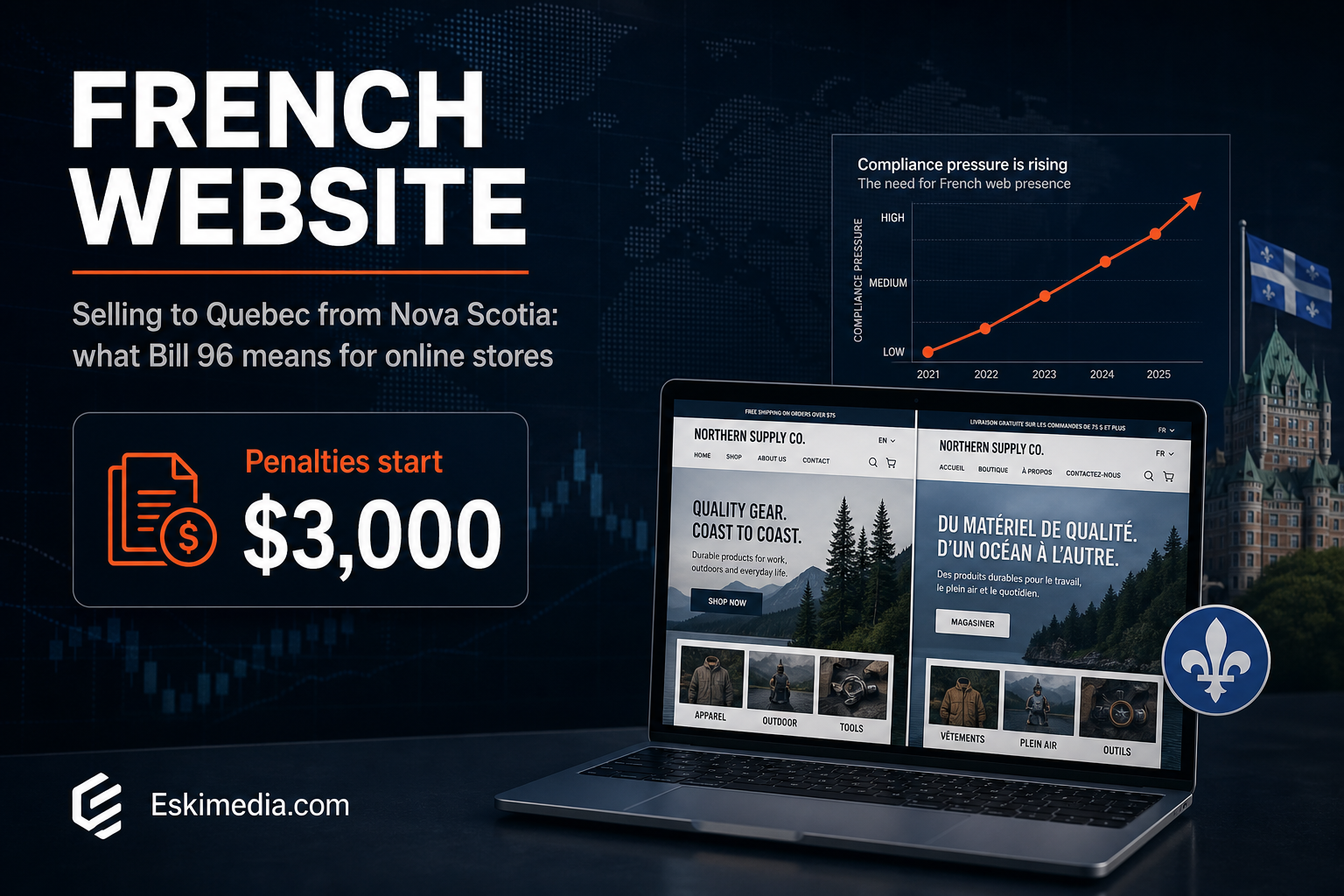
The honest answer has two parts. On paper, Quebec’s Charter of the French Language, strengthened by Bill 96 (now Law 14), expects commercial information offered to Quebec consumers to be available in French, whoever is selling. In practice, for a business with no establishment in Quebec, enforcement is complaint-driven, and the Canadian Federation of Independent Business describes the Office québécois de la langue française’s approach to e-commerce businesses without Quebec locations as incentive-based rather than mandatory.
So the right move depends on how much of your business is in Quebec. This page lays out what the law covers, where the practical risk actually sits, and what to do at each level of Quebec sales. It isn’t legal advice. If Quebec is a significant market for you, get it.
What the Charter Covers for Businesses Selling Into Quebec
| Area | What’s expected | Practical risk for an out-of-province online store |
|---|---|---|
| Website and online store content | Commercial content available in French, on terms at least as favourable as other languages | Moderate. Complaint-driven; grows with your Quebec visibility |
| Product labels and packaging | Inscriptions on products sold in Quebec in French; other languages not more prominent | Higher. This is physical and easy to spot |
| Trademarks on packaging | Since June 1, 2025, descriptive words in a non-French trademark generally need to appear in French on the product too | Higher, for the same reason |
| Terms and conditions (contracts of adhesion) | French must be offered first, or the contract must be in French or bilingual | Moderate |
| Customer service | Customers can be served and informed in French | Lower, unless you get complaints |
| Advertising aimed at Quebec | French | Higher if you actively run ads targeting Quebec |
Penalties for businesses start at $3,000 and rise sharply for repeat violations, according to CFIB’s summary. The Office generally starts with a complaint and a request to comply, not a fine.
Check Your Labels Before Your Website
For many Nova Scotia product businesses, the first language issue isn’t Quebec at all. Federal rules under the Consumer Packaging and Labelling Act already require key information on many prepackaged consumer products sold anywhere in Canada, such as the product’s name and net quantity, to appear in both English and French. There are exemptions, including some for local products, and food has its own rules under the Canadian Food Inspection Agency.
If your labels are English-only and you sell prepackaged goods across Canada, sort this out first. It applies whether or not you ever ship to Quebec.
What to Do at Each Level of Quebec Sales
Occasional orders, no marketing in Quebec
- Make sure checkout works for Quebec addresses and charges the right tax. Quebec has GST plus QST, not HST.
- Get your labels right under the federal rules above.
- Don’t run ads targeting Quebec in English only.
- Be ready to reply in French if a customer writes in French. A translation tool and a polite reply is a reasonable start.
A meaningful share of sales, or you want to grow there
- Build a proper French version of the store: product pages, cart, checkout, shipping and returns information, terms.
- Give it equal footing. A language switcher that’s easy to find, and French pages that are complete, not a translated homepage with English everywhere else.
- Offer your terms and conditions in French.
- Check trademark and packaging text against the June 2025 changes.
Quebec is a core market
- Full French localization, not just translation. Quebec French differs from European French, and customers notice.
- French customer service, French advertising, French email marketing.
- Legal advice on packaging, trademarks and contracts.
How to Add French to a Shopify or WordPress Store
Both platforms handle this well now.
- Shopify: add French as a language in Markets and translate content with Shopify’s Translate & Adapt app or a third-party app. French URLs are created automatically under a subfolder like
/fr/. - WordPress and WooCommerce: WPML, Polylang and TranslatePress are the common options. Each creates separate French URLs and handles the language switcher.
Three things to get right regardless of platform:
- Have a person review machine translation. Automatic translation is a fine first draft. Product names, sizing, measurements and legal text need a fluent reviewer.
- Use proper hreflang tags (
en-CAandfr-CA) so Google shows the right version to the right searcher. Most multilingual plugins and Shopify handle this automatically; check it’s actually there. - Don’t force-redirect by location. Let visitors choose their language and remember the choice. Automatic IP-based redirects frustrate travellers and anglophone Quebecers, and they can stop search engines from crawling one version.
There’s an upside beyond compliance. French-language searches in Quebec tend to be less crowded by stores from outside the province. A properly built French store can rank for searches your English pages never will.
Where This Fits With Other Canadian Rules
Language is one of several rules that change when you sell outside Nova Scotia. Quebec’s privacy law, Law 25, has its own requirements for tracking and cookies, covered in our Canadian website compliance checklist. For platform choice and running costs, see Shopify vs WooCommerce in Canada.
Adding a French version properly, with complete pages, correct hreflang and working language switching, is part of our e-commerce and website work. If Quebec orders are growing and you’re deciding how far to go, send us your store URL and roughly what share of sales comes from Quebec.