
Marketing for Halifax Contractors: How Trades Businesses Fill Their Schedule in 2026

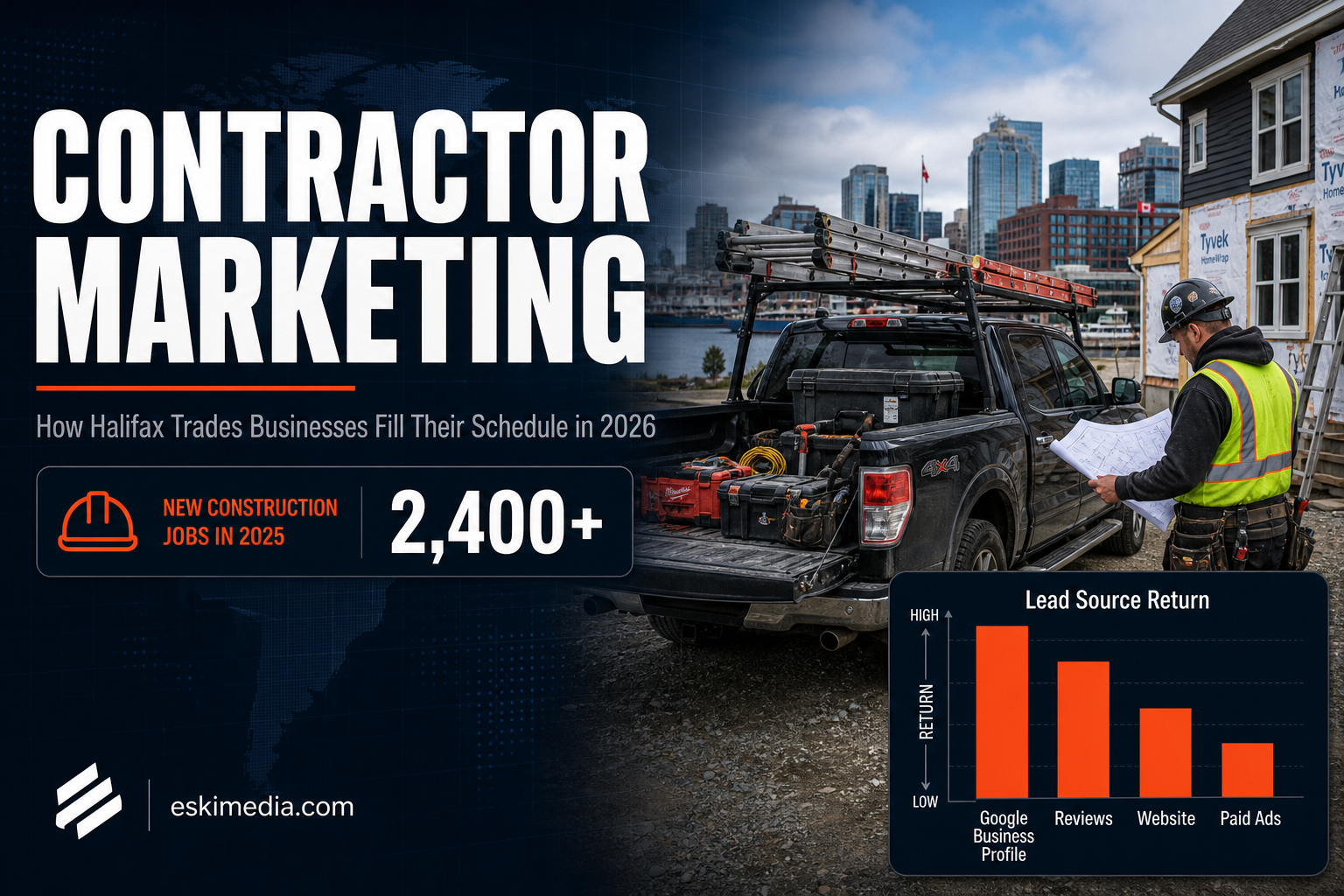
Construction added more jobs in Halifax last year than any other sector, about 2,400 of them, and housing starts hit a record, according to the Halifax Partnership’s Halifax Index. If you’re a contractor here, you’ve probably felt that as either a very good year or a very stressful one, depending on whether the work you got was the work you wanted.
That distinction is the whole point of marketing for Halifax contractors and trades businesses, and it’s why “we’re busy enough” is a weaker argument than it sounds. Being busy with $600 repair calls when you’d rather be doing $40,000 renovations isn’t a demand problem. It’s a lead-mix problem.
The Reason Marketing Feels Optional Right Now
In a strong market, referrals and repeat customers fill the calendar and marketing looks like a cost. The problem is what referral flow gives you: whatever walks in. No control over job size, job type, or geography, so you take the small job in Hammonds Plains because it came from a good customer, and you’re driving 40 minutes each way for a half-day of work.
Marketing, for a contractor, isn’t really about volume. It’s about choosing. And it’s much easier to build while you’re busy than to start when the phone slows down, because everything here takes two to six months to work.
Where Contractor Leads Actually Come From in HRM
In rough order of return for trades businesses in this market:
1. Google Business Profile and the map pack
Someone whose water heater just failed searches “plumber near me” and calls one of the three businesses in the map. That’s it. They don’t scroll, they don’t compare, they call. For emergency and urgent trades this is the highest-intent traffic that exists anywhere online.
Your profile is the whole game for those searches: correct primary category, real photos of your work, and reviews that mention specific services and specific communities. A profile that hasn’t been updated in a year loses to one that gets a new photo every fortnight, because Google’s 2026 local weighting leans on recent activity over accumulated history.
2. Reviews, mentioning the work and the place
“Great service” is worth little. “Replaced our roof in Fairview in two days, cleaned up properly” is worth a lot — it contains a service, a neighbourhood and a timeframe, which is exactly what both Google and prospective customers are reading for.
Ask at handover, in the driveway, while they’re looking at finished work. Not by email three days later. Two to four a month indefinitely beats twenty in a burst.
3. A website that shows finished work and answers the price question
Most contractor websites in Nova Scotia are a logo, a services list, and a phone number. Which is fine for someone who already decided to call you, and useless for someone comparing three options.
What actually converts: photos of jobs you’ve done in identifiable local areas, a straight answer about ballpark pricing, and licensing and insurance stated plainly. Homeowners are nervous about trades (the industry has earned some of that) and the contractor who volunteers “licensed, insured, WCB coverage current, here’s what a typical bathroom runs” wins against the one who makes them ask.
On pricing: you don’t need a price list. A range with the variables named — “most full bathroom renovations we do run $18,000 to $35,000 depending on whether we’re moving plumbing” filters out people who were never going to hire you and builds trust with the ones who will. Silence about price doesn’t read as premium. It reads as evasive.
4. Google Ads, when the job value supports it
Search ads work for trades because intent is unmistakable. Someone typing “emergency electrician Halifax” is not doing research.
Whether it’s profitable depends on job value. If your average job is $8,000 and you close one in five qualified calls, a $60 click is fine. If you’re doing $400 service calls, the same click destroys your margin. Run the arithmetic before you spend: cost per click, calls per click, jobs per call, margin per job. If you can’t fill those four numbers in, you’re not ready to run ads — and any agency that doesn’t ask you for them is not doing you a favour. That’s the first conversation we have on Google Ads for Halifax businesses, and sometimes it ends with us saying don’t.
5. Photos and video of your own work
Trades have the best raw material of any industry for content and use it the least. Before-and-after is genuinely compelling to watch, and a phone in a competent pair of hands is enough to capture it.
The gap is usually the editing, not the filming — footage accumulates and nothing gets made. For larger builds, aerial progress footage is also worth more than most contractors realize, both as marketing and as documentation for the client. We do it as drone videography in Halifax, often on a monthly schedule through a build.
Where Not to Spend
Based on what we see repeatedly:
- Lead-generation platforms that sell the same lead five times. You’re bidding against four competitors on price, on a homeowner who’s now expecting the lowest of five quotes. Occasionally worth it to fill a gap. Ruinous as a primary channel.
- Truck wraps as the main investment. Good for local recognition and worth doing. Not a lead source you can measure or scale.
- Facebook ads for high-value jobs. Interruption-based, aimed at people who weren’t looking. Fine for awareness in a specific neighbourhood, weak for “$30k renovation” intent compared to search.
- Print directories. Still being sold in this province. Still not working.
The Version of This You Can Actually Do
Nobody running a crew is going to do all of the above. So, in order:
- Fix the Google Business Profile properly: category, photos, complete every field. One afternoon.
- Start asking for reviews at handover. Every job, no exceptions, no incentives.
- Put twelve real job photos and a price range on your website. Existing site is fine, this isn’t a rebuild.
- Add a licensing and insurance statement somewhere obvious.
- Then, if the pipeline still needs help, consider paid search.
Steps one through four cost almost nothing and take a couple of days spread over a month. Most contractors skip to step five, which is why paid search has a bad reputation in this industry — it was pointing at a website that couldn’t convert.
If You Want a Second Opinion
We work with trades and construction businesses around HRM, and the honest starting point is usually smaller than people expect. Tell us what your lead mix looks like now and what you’d rather it look like, and we’ll tell you which of the five steps above is actually your bottleneck.