
Service Area Pages for Dartmouth, Bedford and Sackville That Don’t Look Like Doorway Pages

A page for Dartmouth, one for Bedford, one for Sackville. It’s a sensible idea for any business that serves more than one part of HRM, and it’s also the fastest way to end up with ten near-identical pages that Google treats as spam.
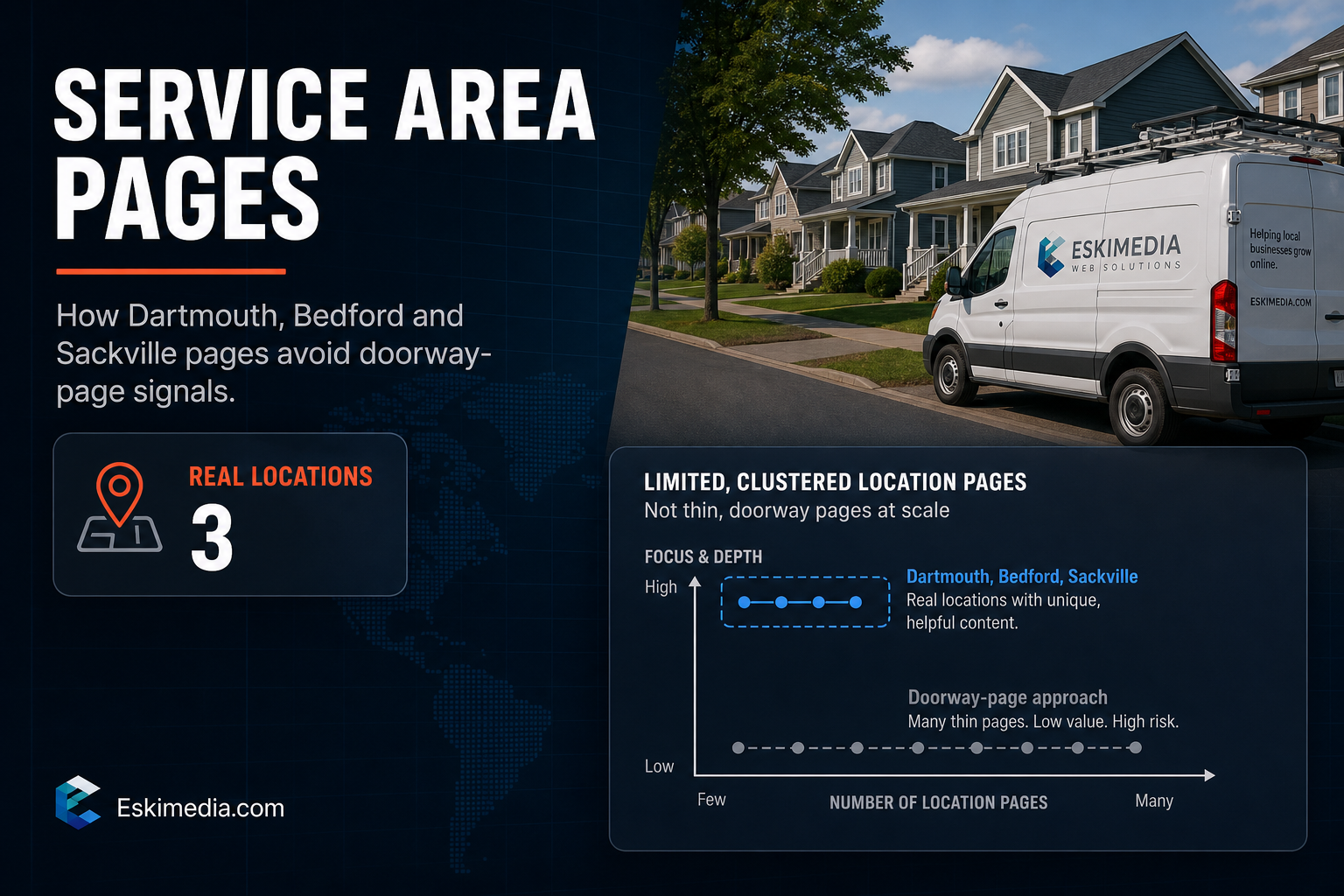
The line between the two is simpler than most guides make it sound. Google’s spam policy describes doorway abuse as “multiple domain names or pages targeted at specific regions or cities that funnel users to one page.” So the test is this: if you deleted the community name from the page, would anything specific to that community be left? If yes, it’s a location page. If no, it’s a doorway.
For most HRM service businesses that means three to six solid pages, not thirty thin ones.
Which HRM Communities Deserve Their Own Page?
HRM covers a huge area, but customers group it in fairly predictable ways. You don’t need a page for every suburb. You need a page for each cluster where you actually work and where people search by that name.
| Cluster | Includes | Worth a page if… |
|---|---|---|
| Halifax | Peninsula, Clayton Park, Fairview, Spryfield, Armdale | This is usually your homepage and main service pages already. A separate page is rarely needed. |
| Dartmouth | Dartmouth, Cole Harbour, Eastern Passage, Woodside | You cross the harbour regularly for jobs |
| Bedford | Bedford, Hammonds Plains, the Bedford West area | You have steady work there and customers search “Bedford” by name |
| Sackville | Lower, Middle and Upper Sackville, Beaverbank, Fall River | You serve the 101/102 corridor |
| Tantallon / St. Margarets Bay | Tantallon, Hubbards, the Bay communities | You’ll actually drive out there and have jobs to show for it |
| Eastern Shore | Porters Lake, Musquodoboit Harbour and beyond | Same: only with real work and a real travel policy |
Two quick filters before you write anything. Have you done enough jobs there to show photos from at least a few of them? Can you name three things about working in that area that aren’t true of the others? If either answer is no, wait until you can.
What Makes a Community Page Genuinely Different
People reach for landmarks and local history to make pages unique. A paragraph about the Dartmouth waterfront doesn’t help someone hire an electrician. The differences that matter are the ones that change the job or the booking.
- Travel and scheduling. How soon can you usually get there? Is there a travel charge beyond a certain point? Do you group Eastern Shore jobs on particular days?
- Service conditions. Much of urban HRM is on municipal water and sewer. Large parts of rural HRM are on wells and septic systems. For plumbers, HVAC installers and irrigation contractors, that changes the work, and it’s a real, useful difference between a Halifax page and a Hammonds Plains page.
- The work you actually do there. Photos and short descriptions of real jobs in that area, with the customer’s permission, and no private addresses.
- Area-specific questions. The questions customers from that area actually ask you on the phone.
- Reviews from customers there. Only genuine ones, quoted accurately. Never write them yourself.
- Limits. If you don’t go past a certain point, say so. It saves you calls you can’t take.
The Name-Removal Test, Applied
Here’s the difference in practice. Both paragraphs below are illustrations written for a heat pump installer, not taken from a real site.
Doorway version: “Looking for heat pump installation in Bedford? Our experienced Bedford technicians provide top-quality heat pump installation to Bedford homeowners. Contact us today for heat pump installation in Bedford.”
Delete “Bedford” and nothing is left. It’s the Halifax page with a word swapped.
Location page version: “Most of our Bedford installs are in the subdivisions around Larry Uteck Boulevard, and we can usually get there the same week you call. Hammonds Plains jobs take longer to schedule because we book them alongside other work out that way, so allow roughly an extra week in winter. If your house still has a 100-amp panel, we check capacity before quoting, since some larger systems need an upgrade first.”
Delete “Bedford” from that and the page still carries information a Bedford customer can use. That’s the standard.
How to Structure and Link the Pages
- Put them in your navigation. A “Service Areas” menu item with the community pages beneath it. Pages that exist only for search engines and can’t be reached from the menu look exactly like doorways.
- Link from your service pages, sensibly. “We also work in Dartmouth and Cole Harbour” with a link, not a footer block of forty town names.
- Keep URLs short and consistent. /service-areas/dartmouth/ or /dartmouth-heat-pumps/ both work. Pick one pattern.
- Keep your Business Profile pointed at your main page. For a single-location business, the website link on the profile should go to the homepage or main service page, not to one community page.
- Add pages as you earn them. One good page when you have the material, then the next. Publishing a batch of templates on the same day is exactly the pattern that raises suspicion.
What These Pages Will and Won’t Do
A good community page helps you rank in the ordinary search results for searches that include the community name, like “heat pump installer Bedford”. It gives Google clearer evidence that you work there, which supports relevance. It also converts better, because a customer from Bedford can see you’ve actually been there.
It won’t move your Google Maps pin, and it won’t override distance in the map pack for “near me” searches made from across the harbour. That’s a separate problem, covered in why a profile ranks in Halifax but disappears in Dartmouth. The two pieces of work support each other, but neither replaces the other.
If you’re trying to set realistic expectations for how quickly any of this moves, how long local SEO takes in a market like HRM covers the timing.
If You Already Have Thin Community Pages
Many sites built a few years ago carry a set of pages like the doorway example above. You have three options for each one:
- Rewrite it if you genuinely work there and can pass the name-removal test.
- Merge it into a broader cluster page (Cole Harbour into Dartmouth, for example) and redirect the old URL with a 301.
- Remove it if you don’t really serve that area, and redirect it to your main service page.
Fewer, better pages almost always outperform a large set of thin ones. It’s also less to maintain.
Writing community pages that pass that test takes information only the business has: where the jobs are, how scheduling works, what’s different about the work. When we build them as part of our local SEO service, we start with a short interview for exactly that reason, then handle the page structure, navigation and redirects on the website side. If your site has a stack of near-identical town pages and you’re not sure which to keep, send us the list.