
How Long Does Local SEO Take in Halifax? A Realistic Timeline for a Smaller Market

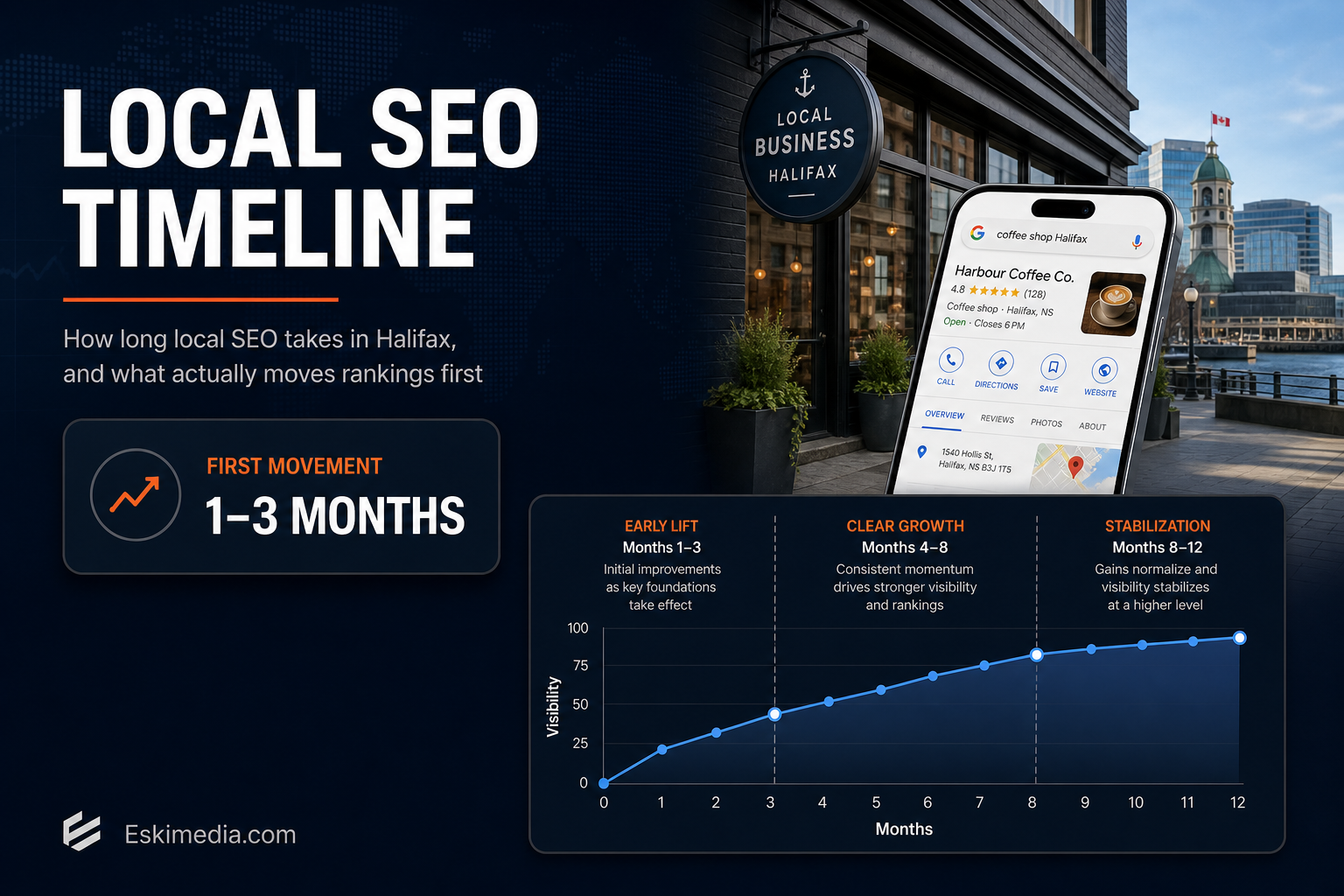
For most Halifax businesses, local SEO shows first movement in the map results within one to three months, and settles into something you can plan around at six to twelve. Google said much the same thing about SEO in general in its 2017 video on hiring an SEO: in most cases it takes four months to a year to implement improvements and then see a benefit.
That’s the honest range. Where your business lands inside it depends on a handful of things you can check yourself in about twenty minutes, and HRM being a smaller market helps with some of them and hurts with others.
What Decides Where You Land in That Range
Five factors do most of the work. None of them is the size of your budget.
| Factor | Faster when… | Slower when… |
|---|---|---|
| How many real competitors show up | The map pack for your main search has a few established businesses and some weak profiles | Every result is a strong, reviewed, long-established business |
| Where you’re starting from | You have a verified profile and a website that’s been live for years | New business, new domain, or a profile that was just created or suspended |
| The review gap | Your review count is within reach of the top three | The leaders have several hundred reviews and you have a dozen |
| What’s broken | The problems are technical: wrong category, missing pages, a noindex tag | There’s nothing broken; you simply need more authority than competitors |
| Location | Your address sits near where customers search | You’re trying to rank in a community across the harbour from your address |
The last one surprises people. Distance from the searcher is one of Google’s three local ranking factors, and no amount of work removes it. If most of your customers are in Dartmouth and your address is in Clayton Park, read why a profile ranks in one community and not the next before you set expectations.
Does a Smaller Market Make Local SEO Faster?
Sometimes. HRM has far fewer businesses per category than Toronto, so in many trades the map pack is winnable with basics done properly: the right primary category, a complete profile, a steady flow of reviews and a website that clearly describes what you do and where.
The catch is that small markets tend to have entrenched leaders. A business that’s been collecting reviews since 2015 has a lead that takes time to close, even if everything else about your setup is better. In practice, the categories that move fastest here are ones where the top results are thin: unclaimed profiles, websites that haven’t been updated in years, businesses with a handful of reviews.
Check Your Own Market in 20 Minutes
You don’t need a tool to get a rough read on how long this will take for you.
- Search your main service the way a customer would, from a phone near your address. Note the three map results.
- Open each profile. Write down review count, rating, primary category and when the newest review was posted.
- Click through to their websites. Is there a dedicated page for the service you searched, or just a homepage listing everything?
- Repeat for two or three other services you want to be found for.
- Compare yourself honestly against the weakest of the three, not the strongest. That’s the business you need to pass first.
If the weakest map result has 20 reviews, a vague category and no service page, you’re looking at the faster end of the range. If the weakest has 150 reviews and a thorough website, plan on the longer end, and consider whether ads should carry some of the load while the organic work builds.
What Tends to Happen, Month by Month
This is the typical sequence when the work is done in a sensible order. Your timeline will stretch or compress with the factors above.
Month 1: fixes that can show quickly
Primary and secondary categories corrected. Services and business description filled in. Photos added. Obvious website problems fixed: missing service pages, pages blocked from Google, a phone number that isn’t clickable on mobile. If something was actively broken, this is where the quickest gains come from, sometimes within a few weeks.
Months 2 to 4: relevance and reviews
Service pages written properly. A community page for each area you genuinely serve. A routine for asking every happy customer for a review, which matters more than any single burst. Our guide on getting more Google reviews within the rules covers how to build that routine. Map positions start moving for secondary searches before the main one.
Months 4 to 8: the competitive searches
This is where your main, most-searched term either breaks into the top three or doesn’t. It’s also where the gap between you and established competitors shows up most clearly. Local mentions and links from other HRM organisations start to matter here.
Months 8 to 12: holding position
Rankings settle. The work shifts from fixing to maintaining: fresh reviews, new photos, updates when services change, and watching for competitors who start doing the same things.
How to Tell If It’s Working Before Rankings Move
Rankings lag. These signals usually move first, and they’re all free to check.
- Business Profile performance. Calls, direction requests and website clicks, compared month over month and against the same month last year. Seasonal trades in Nova Scotia swing hard; comparing October to July tells you nothing.
- Search Console impressions for your service pages. Impressions rise before clicks do.
- Grid rankings for secondary searches. “Heat pump installation” often moves before “HVAC”.
- Where new customers say they found you. Ask on every call for a month. It’s the least technical and most reliable signal there is.
If none of these has moved after three months of real work, something in the plan is wrong. That’s the point to ask hard questions, not month eleven.
What Can’t Be Rushed, and Promises to Be Wary Of
Some things take the time they take. Reviews arrive at the pace you serve customers. Trust in a new domain builds over months. Google’s own guidance is explicit that there’s no way to pay for a better local ranking.
Be cautious with anyone who guarantees first place or the top three by a date. Google’s own advice on hiring an SEO is blunt: no one can guarantee a number one ranking on Google. Also watch for shortcuts that create risk: buying reviews, keyword-stuffing your business name, or renting a virtual office to get a second address. Each can produce a quick bump. Each can also get the profile suspended, which puts you back at month zero.
When Paying for Ads in the Meantime Makes Sense
If the check above points to the long end of the range and you need calls this season, run local search ads alongside the SEO. They start producing traffic as soon as they’re approved, and the search terms report tells you which services and communities actually bring jobs, which is useful data for deciding where the organic work should focus. Once organic visibility catches up, the ad budget can shrink. We cover the trade-offs in Google Ads vs Facebook Ads for Halifax businesses.
Where We Start
When we take on a local SEO client, the first thing we build is a map of where they rank across HRM for the searches that matter, alongside the competitor check described above. That tells us which end of the range they’re realistically at before anyone commits to a monthly plan. Our SEO plans start at $199 a month. If you’d like that first read on your own market, send us your business name and the three searches you most want to win.